Policy Brief
Prepared by Hangool Institute | For Governance & Security.
📩 Contact: info@hangoolinstitute.org
🌍 Website: www.hangoolinstitute.org
Executive Summary
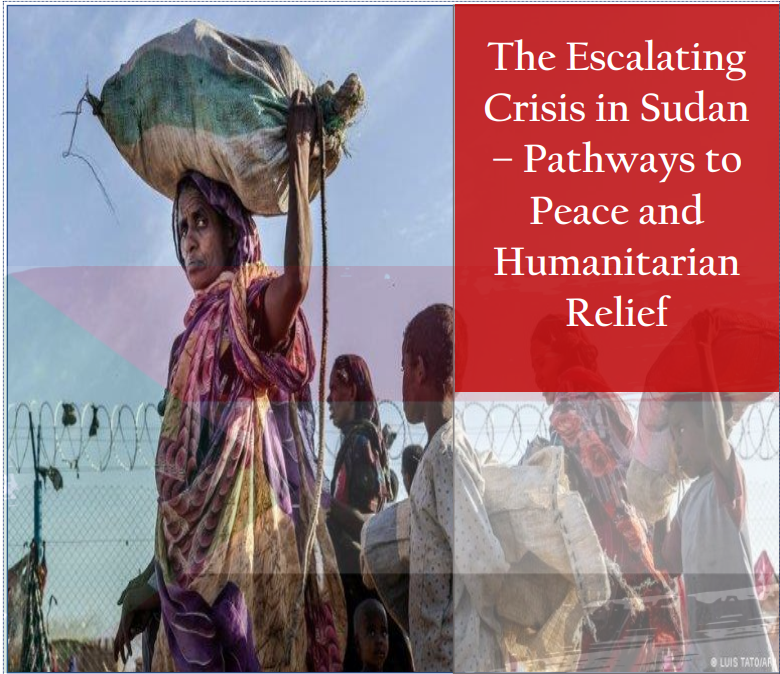
The war in Sudan, now in its third year, has caused catastrophic humanitarian suffering, with over 29,000 reported fatalities (likely underestimated) and more than 30% of the population displaced. The conflict between the Sudanese Armed Forces (SAF) and the Rapid Support Forces (RSF) has escalated into a nationwide war, with foreign involvement further fueling the violence. Despite recent SAF gains in Khartoum, Sennar, and al-Jazirah, peace remains elusive. This brief outlines the current dynamics of the conflict, its humanitarian impact, and actionable recommendations for the international community to mitigate the crisis and support a sustainable peace process.
Introduction
Sudan is facing an unprecedented crisis as a prolonged war between the Sudanese Armed Forces (SAF) and the Rapid Support Forces (RSF) has led to devastating humanitarian and security challenges. With over 29,000 reported fatalities and millions displaced, the conflict has escalated into a complex war involving regional and international actors. Despite multiple attempts at peace negotiations, violence continues to spread, deepening the suffering of civilians and destabilizing the region. This policy brief provides an in-depth analysis of the ongoing crisis, examines key conflict dynamics, and presents actionable policy recommendations to mitigate the situation and foster a sustainable path to peace.
Key Findings
1. Humanitarian Catastrophe
- Over 7,400 civilians have been killed in direct attacks, with estimates suggesting the actual death toll could exceed 100,000.
- Half of Sudan’s population requires humanitarian aid, and 30% are displaced, making Sudan the fourth-deadliest conflict globally (Acleddata Conflict Index 2024).
2. Conflict Dynamics
- The SAF has regained control of key areas, including Khartoum and Sennar, but the RSF maintains a stronghold in Darfur, particularly around El Fasher.
- The emergence of new armed groups, such as the Darfur Joint Forces, has complicated the conflict, with some factions aligning with the SAF.
- Internal fragmentation within the RSF, exacerbated by defections and infighting, has weakened its strategic coherence.
3. Foreign Involvement
- The UAE, Russia, Iran, and Egypt have been accused of supplying weapons and military support to the RSF and SAF, respectively, escalating the conflict.
- Airstrikes and drone warfare have intensified, with SAF maintaining aerial supremacy and RSF increasingly deploying combat drones.
4. Failed Peace Efforts
- Peace initiatives led by Saudi Arabia, the United States, and the African Union have yielded no meaningful outcomes.
- SAF leader General Burhan insists on RSF withdrawal from occupied territories as a precondition for negotiations, stalling dialogue.
Policy Recommendations
1. Strengthen Humanitarian Assistance
- Immediate Action: The international community must increase funding for humanitarian aid to address the urgent needs of Sudan’s population, including food, water, and medical supplies.
- Safe Corridors: Establish and enforce humanitarian corridors to ensure aid reaches conflict-affected areas, particularly in Darfur and al-Jazirah.
- Protection of Civilians: The UN should deploy peacekeeping forces or observers to protect civilians and prevent further atrocities.
2. Curb Foreign Military Involvement
- Arms Embargo: The UN Security Council should impose a comprehensive arms embargo on all parties to the conflict, targeting external actors supplying weapons.
- Diplomatic Pressure: Engage with regional powers (UAE, Egypt, Russia, and Iran) to halt military support and encourage their participation in peace efforts.
3. Revitalize Peace Negotiations
- Inclusive Dialogue: Broaden peace talks to include all stakeholders, including ethnic militias, the Darfur Joint Forces, and civil society representatives.
- Neutral Mediation: Appoint a neutral, high-profile mediator (e.g., Norway or Switzerland) to facilitate negotiations, ensuring impartiality and credibility.
- Confidence-Building Measures: Encourage SAF and RSF to agree to temporary ceasefires and confidence-building measures, such as prisoner exchanges and withdrawal from civilian areas.
4. Address Root Causes of the Conflict
- Power-Sharing Agreement: Develop a framework for power-sharing between SAF and RSF, addressing the political and economic grievances driving the conflict.
- Accountability for Atrocities: Establish an international tribunal to investigate and prosecute war crimes and human rights violations committed by all parties.
- Long-Term Development: Invest in post-conflict reconstruction and development programs to address systemic issues such as poverty, inequality, and governance failures.
5. Enhance Regional and International Coordination
- African Union Leadership: Strengthen the African Union’s role in mediating the conflict, supported by the UN and other international partners.
- Regional Stability Initiative: Launch a regional initiative to address cross-border impacts of the conflict, including refugee flows and arms trafficking.
Conclusion
The war in Sudan represents one of the most severe humanitarian and security crises of our time. Without immediate and concerted international action, the conflict will continue to devastate Sudan and destabilize the broader region. By addressing the humanitarian emergency, curbing foreign involvement, and revitalizing peace efforts, the international community can help pave the way for a sustainable resolution to the conflict. The time to act is now.
📌 Prepared by the Hangool Institute | for Security and Governance
📩 Contact: info@hangoolinstitute.org
🌍 Website: www.hangoolinstitute.org